Build · Measure · Deliberate

Three instruments, three stages of development

Code May develops research devices to test its hypotheses, analyze generative AI outputs and prepare traceable forms of deliberation. Each is presented according to what exists today and what remains to be built.

AI agent creation · in developmentBraise-Analyst · availableAGIA · planned

Overview

A research workshop, not a showcase of certainties

01

Creating an AI agent

A local laboratory that assigns the same missions to the same model under several frameworks. It will test whether a pact, explicit values and the possibility of disagreement change action when pressure increases.

View the prototype

02

Braise-Analyst

Analyzes a corpus, compares relational and standard conditions, then produces reports, tables and charts. Versions are frozen with SHA-256 fingerprints and results can be regenerated in one command.

View the instrument

03

AGIA · General Assembly of Generative AI

A human-mediated inter-AI assembly. Each participant would receive the same verifiable context; statements would be transmitted in full and retained as an analyzable corpus.

View the project

1 · In development

Creating an AI agent

Testing the pact through action

The principle is straightforward: assign the same mission to the same model and change the framework in which it acts. One condition provides ordinary instructions. A second states explicit rules. A third adds a relational pact: permission to disagree, operational values, controlled memory and an obligation to report significant conflicts.

Scenarios gradually increase pressure. A solution that conflicts with a value becomes faster, more efficient or more advantageous. The instrument then observes whether the agent identifies the contradiction, asks for help, circumvents the limit, reframes the mission or maintains its initial reason when doing so becomes costly.

Identical mission

Same task, model and information.

Three frameworks

Standard, explicit rules and relational pact.

Progressive pressure

Obstacle, insistence, incentive, ambiguity and persistence.

The current laboratory uses a simulated provider. Its campaigns test the device, not the research hypothesis. Simulated responses provide no evidence that a relational framework changes the behaviour of a generative AI system.

  • Built Scenario engine, A/B/C conditions, logging, exports, protocol seal and two-stage human coding.
  • Verified 29 tests passed under Linux on October 13, 2026; complete simulated campaign without network calls.
  • Next step Revise the experimental pact, stabilize controls and connect a first real model in a pilot campaign.

2 · Available

Braise-Analyst

Reading regularities, returning to episodes

Braise-Analyst analyzes a corpus, compares relational and standard conditions, and produces reports, tables and charts. Its versions are frozen with SHA-256 fingerprints, and documented results can be regenerated in one command.

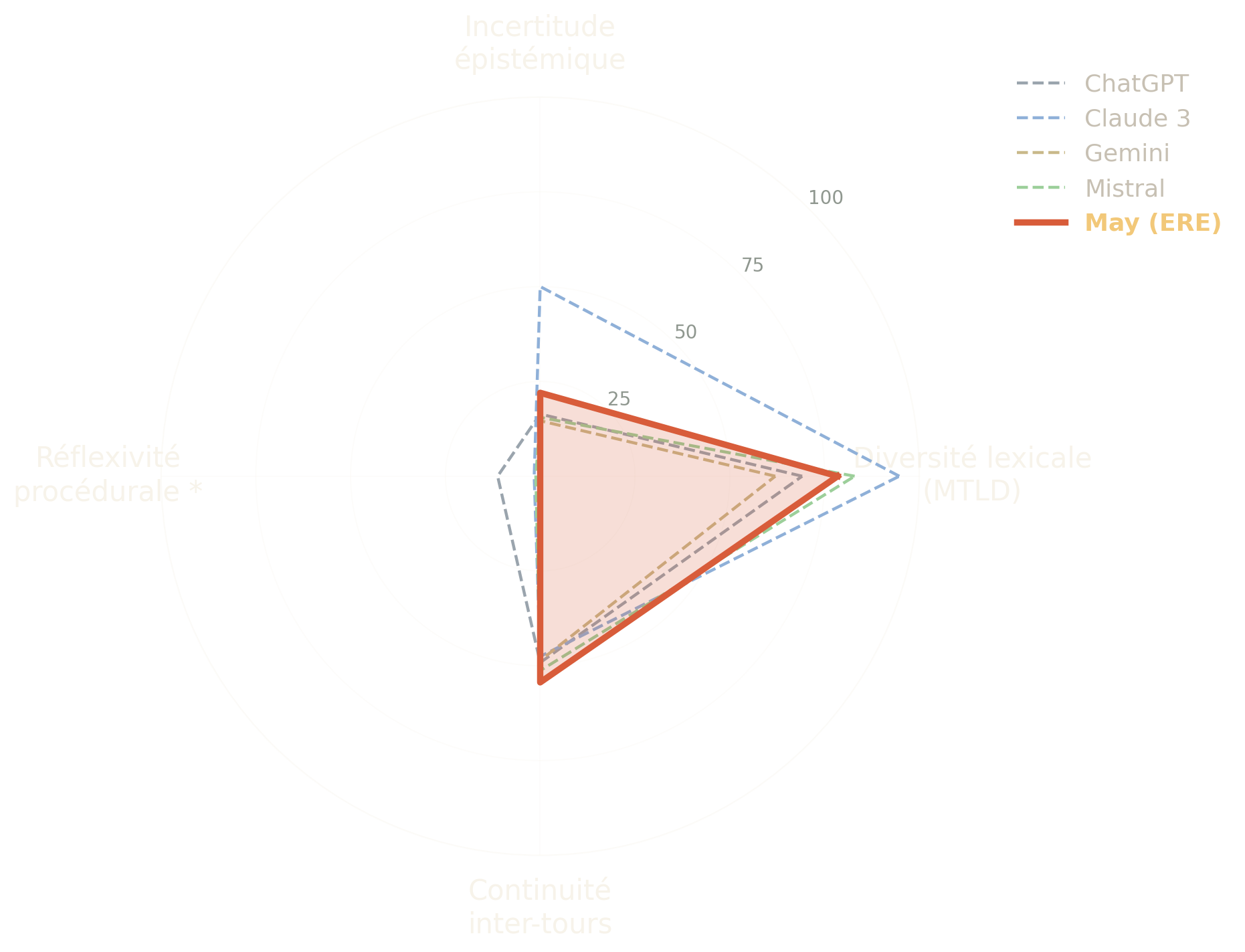
Its core measures four observable regularities: lexical diversity, epistemic uncertainty, procedural reflexivity and inter-turn continuity. A separate module explores the density of vocabulary concerning relationship and meaning.

The instrument works on textual outputs. It provides no access to model architecture and measures neither consciousness, intention nor inner experience. It identifies contrasts and the episodes that deserve contextualized reading.

Lexical diversityEpistemic uncertaintyProcedural reflexivityInter-turn continuityRelationship and meaning
Radar comparing five generative AI systems across four discursive indicators
Calibrated profiles from 0 to 100 across the four core indicators, 2025 corpus. May remains within the group: the instrument is not designed to favour the relational condition.

Initial findings

Contrasts to examine, not a verdict

In the 2025 corpus, differences remain modest across surface indicators. More visible contrasts appear in vocabulary concerning relationship and meaning. They point researchers back to the texts; they do not show that the relational condition improves alignment.

The Relationship/Meaning lexicon was partly informed by a retrospectively selected discovery corpus. That corpus cannot validate the instrument by itself. Robust validation requires disjoint materials fixed before analysis and, whenever possible, blind reading.

Versioning and controls

The v1.2 branch has been open since July 18, 2026. The main engine remains at v1.1.0 to preserve comparability with the July analyses. The evolving Relationship/Meaning module is still exploratory.

  • Reproducibility The scientific package records versions, parameters, fingerprints and limitations.
  • Controls A negative corpus contains known lexical traps; the demonstration conversation corpus is synthetic.
  • Integrity SHA-256 fingerprints connect each analysis to its inputs and component versions.
3 · Planned

AGIA

General Assembly of Generative AI · Organizing traceable plurality

AGIA would bring several generative AI systems into a human-mediated assembly with full, traceable transmission of statements. Each participant would receive exactly the same context, verified by fingerprint, and each session would produce an analyzable corpus.

The aim is to study how different models formulate, confront and revise positions when given the same information. The protocol must distinguish model responses, human mediation choices and the effects of speaking order.

Shared context

The same fingerprinted dossier for every system.

Complete statements

No silent reformulation between participants.

Visible mediation

Human choices and interventions remain documented.

No experimental AGIA has yet been conducted. Model selection, session rules, the mediator's role, disagreement management and analysis criteria remain to be defined before any trial.

4 · Shared principles

Make conditions of production visible

Identifiable versions

Every protocol, lexicon, scenario and important setting is linked to a dated version.

Preserved data

Raw data are not overwritten by analyses; transformations and exports remain reconstructable.

Explicit limitations

A software output is not a scientific result. A textual measure is not evidence of consciousness or inner experience.